

MTC & SolutionsPT help bring Factory in a Box to reality
 Aaron Blutstein 23 May 2022
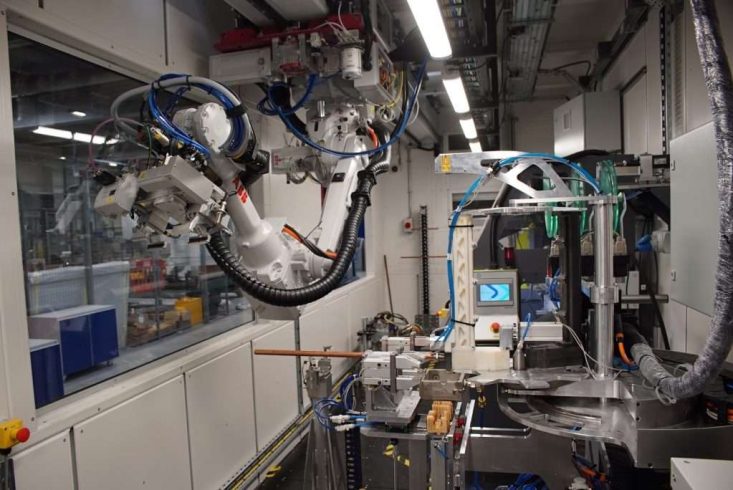
The Manufacturing Technology Centre (MTC) works closely with a range of technology vendors and digital transformation partners, as has been exemplified by a project called Factory in a Box (FIAB), which uses AVEVA software deployed through the knowledge sharing expertise of AVEVA’s sole UK and Ireland distributor, SolutionsPT. Smart Futures reports.
The manufacturing sector is a fast moving and competitive space which has helped shape the nature of international trade, as much as it has shaped the nature of modern life, through constant innovation. After generations of globalisation, the seas and skies of the world shift products of all kinds to and from every corner of the globe. The benefits of localised production, such as reduced shipping and speed to market have often been limited to companies with the size and strength to create new manufacturing resources close to their established markets. Even for companies capable of this, the cost and risk associated make it a daunting challenge.
However, in the era of digital transformation, the MTC has shown UK companies that the manufacturing process itself can be packed into a box and shipped anywhere, ready for speedy deployment, and rapid global expansion with localised production, at a reduced cost and risk.
Factory in a Box (FIAB) is transported in a single shipping container. The mobile factory uses smart sensors, and big data capabilities, to measure and control production processes accurately using a standard internet connection from anywhere in the world. Considered a significant breakthrough, the digital technologies demonstrated on FIAB offer companies of all sizes the ability to take a mobile, agile-manufacturing approach to scale.
The starting point of this revolutionary new technology was an MTC demonstrator. Basem Salam, Senior Research Engineer, the MTC explains: “At the MTC we are dedicated to inspiring British manufacturing and aiding UK companies with overcoming specific industry challenges. The demonstrators act as a showcase for the latest technology and provide a risk-free environment to evaluate innovations and ease their transition into company-wide operations. Once a demonstrator is complete, we invite other UK manufacturers to view and assess the technology against their own specific needs. We believe whole-heartedly in the UK manufacturing sector and are completely committed to offering opportunities for its continuous improvement.
“The Factory in a Box demonstrator was an Innovate UK funded project spanning three years. The first selected use case was a thermal energy company that makes clean energy engines for refrigerated vehicles. Due to the complex nature of the product and strict standards associated with production, there’s a shortage of skilled personnel that can inspect it and approve it for use. With Factory in a Box it became possible to move a production facility of this complex part to the site of assembly while still ensuring it was produced to the highest possible standard.”
While this example was for a very specific use case, the implications and possibilities are far reaching. Since the demonstrator’s conception in 2016, the Factory in a Box presented an innovation approach that can benefit manufacturing companies in different sectors. From large companies that want to manufacture key components at point of assembly to small companies looking to enter the market for the first time without the greenfield expense of establishing a traditional manufacturing plant.
Basem added: “The Factory in a Box represents the very height of digital transformation and automation capabilities. Within the single shipping container are the capabilities for digital twins, full traceability, quality management and predictive maintenance. Whilst the facility itself is small, the ramifications of these capabilities combined are huge. SMEs can experience true engineering excellence whether they are producing a run of products or a highly specialised one-off order.”
Industry challenges
FIAB addresses several supply-chain challenges that have remained prevalent within manufacturing for some time now. The days of creating a huge mega factory that produces vast amounts of low value products for export around the world have come to an end; the consumer is changing. Now, customers expect products to be highly customised and adhere to specific local demand and standards. FIAB enables manufacturers to achieve that flexibility. With agile deployment, products can be manufactured closer to the market or customer reducing shipping costs and associated carbon footprint.
David Baskett, Technology & Management Strategy, SolutionsPT explained: “In the post-Covid world we can see just how fragile supply chains are, and if one link is broken, it can have a lasting effect on a manufacturer’s ability to service their customers. Massive global corporations with extensive warehoused stock may not be too badly affected, but for SMEs it can make or break a business.”
Manufacturers facing supply chain issues suffer lost orders, increased delivery time and changing costs. To offset this negative trend many manufacturers are looking to produce overseas and enter new markets, but this is only possible if you have the supply chain and production facility to support it. For smaller companies, having a production facility abroad would be too costly to make business sense. Other time-consuming supply chain issues like replacement parts for legacy equipment or updating outdated software that is no longer compatible are also solved through the FIAB approach. Manufacturers can rest easy when it comes to meeting industrial standards, as FIAB units are up to code in all aspects of physical safety to cybersecurity.
Beyond mobile
The potential impact of FIAB is wide reaching for manufacturers large and small and is not limited to localised, mobile manufacturing. Companies can deploy a FIAB alongside their existing manufacturing to show a template of digital transformation or experiment with a new product without halting production on the main line. Smaller companies can forgo the large greenfield expense, or requirement to outsource manufacture and begin fabricating a product very quickly, lowering the barrier to market-entry and the risks associated with outsourcing. The scalable nature of the solution means that if a company is seeing success, then further FIABs can be added to raise production volume very quickly, without further development costs, simply by replicating existing FIABs and shipping them to where they are needed.
FIAB deployment
Deploying the FIAB requires minimal effort. Using software features such as stock use optimisation, scheduling optimisation, with traceability and quality assurance enabled, the manufacturing process is optimised from the start.
The applications and functionality of FIAB are almost limitless and include examples such as pipe cutting, material moulding or chemical separation to name just a few evidenced from successful demonstrations. With the support of the engineering capabilities and services of the MTC available throughout the demonstrator proof of concept, companies can build a fully developed and tested FIAB, ready to deploy anywhere in the world, in a matter of weeks. Once a FIAB is built, it can be replicated easily, offering huge development savings compared to traditional localised manufacture.
Helping hand
Bringing the FIAB from concept to a fully working demonstrator is a great example of the forward thinking and technical capability of MTC. By bringing the expertise of MTC staff together with leading vendors and solutions consultants, the MTC has created a uniquely powerful concept and resource for UK manufacturers.
MTC worked closely with AVEVA sole UK & Ireland distributor and leading digital transformation partners SolutionsPT to bring the FIAB to reality. Alongside SolutionsPT, MTC was able to bring not just the best-in-class software that AVEVA offer, but extensive expertise in how to maximise its benefit.
Baskett highlighted: “The journey with the MTC, as with so many of our partners, is one that has blossomed over many years. The FIAB project is built on the trust and understanding of the two organisations. Initially, we were brought in to help bring AVEVA Historian software to FIAB, but this quickly morphed into discussions about other software applications that could help bring FIAB to life.
SolutionsPT went on to provide the control software in the form of AVEVA System Platform and, in particular, its data-driven contextualised Operations Management Interface (OMI). Providing a collaborative approach to empower operators, the real-time data stream means efficient maintenance practices and improved situational awareness whether that is a single FIAB deployment or a manufacturing enterprise.
Basem added: “This really ticked the box for us, working closely with SolutionsPT to implement the AVEVA software meant the right data from the right level was presented to the operator at the right time. This architecture was created for the demonstrator but has brought value to many UK manufacturers. With SolutionsPT close on hand we are able to modify the architecture based on individual needs of the manufacturers, even outside of FIAB deployments.”
The benefits of collaboration
SolutionsPT was a key part partner in the FIAB project, says Basem. It integrated itself with the development team and provided guidance and support that smoothen the implementation stage. He added: “When companies come to view the architecture of the demonstrator, even if it isn’t specifically applicable to them, they can see the value it brings. From there we can implement elements of the architecture into traditional production facilities and all the benefits that come with it, in any sector.”
For SolutionsPT, FIAB is also a great example of what is made possible by working closely with organisations that share a commitment to the future of UK manufacturing.
In addition, FIAB demonstrates that efficient, flexible and agile manufacturing operations are now available for SMEs looking to enter new markets. Meanwhile, more established manufacturers can now be more agile and disruptive in testing new products and new markets with reduced risk by leading with FIAB. With further benefits to customers of localisation, including reduced import duties, shipping, and localised compliance, FIAB offers significant advantages to manufacturers, customers, and consumers alike.
Factory in a Box represents a kind of packaged digital transformation; a single deployment for a multitude of industrial capabilities that could previously only be achieved by the companies with largest budgets. The collaboration between the MTC and SolutionsPT has resulted in a superb example of the opportunity for UK manufacturing in the age of digital transformation.
The Manufacturing Technology Centre (MTC) has grown quickly since it was established in 2010 to become a vital resource for UK manufacturers in the era of digital transformation. The organisation, headquartered in Coventry, with further sites in Liverpool and Oxford, including the Advanced Manufacturing Training Centre, Digital Manufacturing Accelerator and the National Centre for Additive Manufacturing. With more than 800 talented employees dedicated to supporting UK manufacturing, it offers a range of capabilities, including technology demonstrators where companies can work closely with experienced engineers to test applications of the very latest technologies.

