

Aiming to cure hand paralysis
 Leslah Garland 16 November 2022
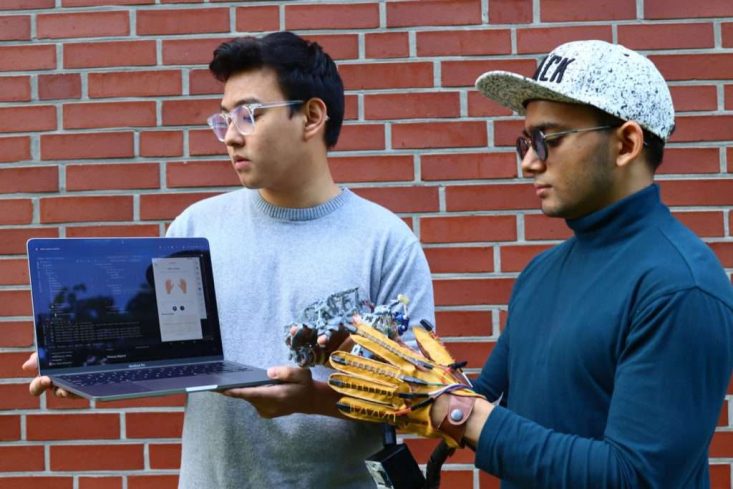
Zain A. Samdani and Ramin Udash, both students at Jacobs University have scored first place in the Microsoft Imagine Cup 2022 with ExoHeal which aims to cure hand paralysis, in the process earning $100,000 USD in prize money and an incredible amount of recognition from medical professionals, investors and affected people.
“Winning the world finals has helped us a lot in spreading the word about our cause. We are over the moon about that,” Samdani said. The 22-year-old has since been awarded another prize – the “Diana Award 2022.” Named after the Princess of Wales, who died in 1997, it honours young people worldwide for their humanitarian work.
Their cause – that is to develop an accessible, inexpensive and effective method of treating hand paralysis using an exoskeleton, a robotic support structure. Samdani developed the idea when at age 16 he first met a distant uncle who was partially paralysed after a stroke and could barely hold a spoon with his hand. “I thought it was unfair that he didn’t get the treatment he deserved,” Samdani recalled. “Many people are affected by paralysis. While there are technically advanced treatments, they are far too expensive for most.”
Samdani, who grew up in Hyderabad, India, and has been involved with robotics since childhood, began researching. He spoke with neurologists, as well as other experts and started the “ExoHeal” initiative. Initial tests with the support structure soon proved successful. The robotic glove mirrors the movements of the healthy hand, and each individual finger can be trained. In the first trials, the recovery process accelerated considerably for around one in three users.
At Jacobs University, where Samdani is studying Robotics and Intelligent Systems in his second year, he met Udash. The 19-year-old from Nepal is studying Computer Science and reinforces the “V-Bionic” startup, founded by Samdani, with a focus on app development. The app monitors, for example, the training schedule for the hand determined by the doctor, suggests exercises based on the user’s routines, and serves as a means of communication between doctor and patient.
When the team applied for the Microsoft Cup, their focus was not on winning: “Winning wasn’t our motivation,” Udash recounted. “With ExoHeal, we want to create something that makes a difference, that benefits many. The competition was just an opportunity to help us do that.”
And a great opportunity, it was. Not just their outreach has increased. Now V-Bionic has $100,000 USD in its bank account, a $50,000 USD credit for using Microsoft’s Azure cloud platform, and an appointment with an influential mentor: Microsoft CEO Satya Nadella.
The money, of course, entirely benefits the startup. They now want to develop the prototype to production readiness and optimise the app. They are investing in machine learning and artificial intelligence techniques to improve therapeutic options. And they want to expand their international team of six members and are looking for partners from the fields of robotics, graphics and machine learning.

